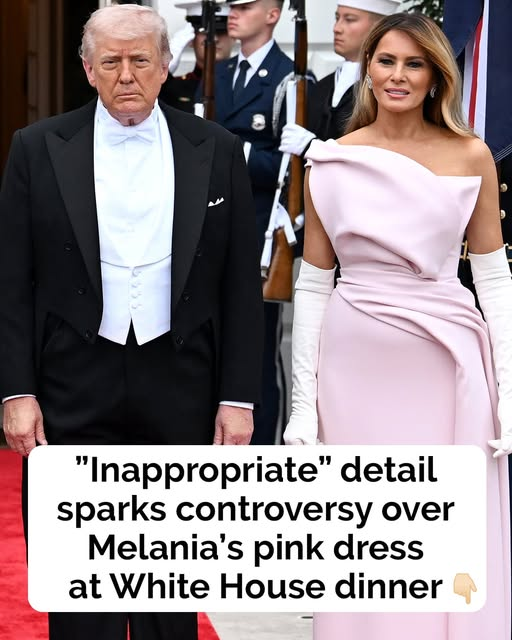
Under the glittering chandeliers of a White House state dinner, where every gesture is measured and every photograph becomes part of history, Melania Trump made a choice that immediately divided public opinion. Standing beside King Charles III and Queen Camilla during their state visit to the United States, she appeared in a pale pink Christian Dior Haute Couture gown — strapless, sculptural, and unmistakably modern. Vogue described the gown as a powder pink Dior couture look with a column-like silhouette, worn during the state dinner for the royal visit.
At first glance, it was simply a fashion moment. But in the world of diplomacy, especially when royalty is involved, fashion is rarely just fashion. Every color, neckline, designer, and silhouette carries meaning. What a first lady wears at a state dinner is not only about elegance; it is about respect, symbolism, national identity, and the silent language of protocol.
That is why Melania’s gown became such a talking point. Instead of choosing a modest white or traditionally conservative silhouette, she stepped into the room in a strapless pink Dior design that instantly drew attention. To admirers, it was controlled, polished, and daring in the way Melania Trump’s style often is. To critics, it felt too bold for the occasion — too bare, too expensive-looking, and too focused on personal image in a setting built around diplomatic formality.
The debate grew even louder because Queen Camilla also wore pink that evening, though in a different tone and style. Business Insider noted that Melania and Camilla’s outfits appeared to harmonize throughout the visit, describing the choices as a form of “visual diplomacy.” That detail changed the conversation. Was Melania breaking protocol, or was she participating in a carefully coordinated style message meant to show warmth between the United States and Britain?
Still, social media rarely waits for nuance. Within hours, photos of the gown spread across platforms. Some users praised Melania for looking elegant and composed. Others accused her of trying to overshadow the royal guests. A third group seemed less interested in etiquette and more captivated by the spectacle itself — the contrast between old-world monarchy and modern political glamour.
That tension is exactly why the image lingered. Royal events are built on tradition. There are expectations of restraint, modesty, and symbolic order. A state dinner involving a British monarch is not a red carpet, even if the cameras make it feel like one. But Melania has long understood how to use clothing as armor. Her fashion choices often feel deliberate, almost architectural — designed not to invite warmth, but to project control.
The Dior gown fit that pattern. Its soft pink color gave it a romantic surface, but the structure made it feel strong, almost untouchable. It was feminine without being fragile. It was glamorous without appearing accidental. Whether one loved it or disliked it, the gown did what powerful fashion is supposed to do: it forced people to look.
The larger question, however, is not only whether Melania followed protocol. It is why the public cares so deeply when women in political spaces use fashion to define themselves. Male leaders at state dinners are usually protected by uniformity — dark suits, white ties, polished shoes, familiar silhouettes. Women, especially first ladies and queens, are judged through a much narrower and more emotional lens. Too plain, and they disappear. Too bold, and they are accused of disrespect.
That is the impossible space Melania walked into. If she had worn something safer, the evening may have passed with little discussion. Instead, she chose a gown that made her visible. For supporters, that visibility was confidence. For critics, it was provocation. For fashion watchers, it was another example of clothing becoming diplomacy without a single word being spoken.
In the end, the ceremony continued without disruption. The dinner was held, the photographs were taken, the official gestures remained intact. Nothing about the evening collapsed because of a dress. Yet the conversation around the gown outlasted the event itself.
That may be the real power of the moment. Melania Trump’s pink Dior gown did not just decorate a state dinner. It exposed the fragile line between tradition and individuality, between respect and self-expression, between blending in and being remembered.
And long after the chandeliers dimmed and the formal speeches ended, one question remained: in a world obsessed with protocol, is it worse to offend tradition — or to vanish quietly inside it?