
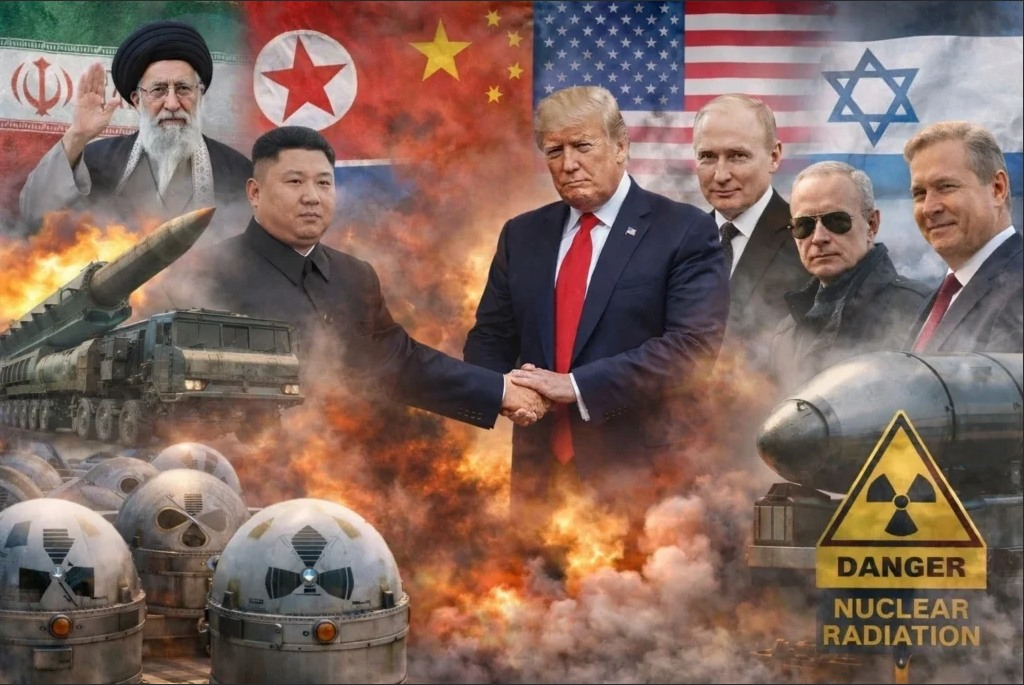
In geopolitics, words are rarely accidental—and some are chosen precisely because of the reaction they provoke. That was the case when a senior Russian lawmaker recently warned that tensions surrounding Greenland could mark “the beginning of the end of the world.” The phrase sounds apocalyptic, but beneath it lies a more calculated message: a signal of how seriously Moscow views shifting power dynamics in the Arctic.
At the center of this growing tension is the renewed discussion by Donald Trump about potential U.S. control over Greenland. While the idea initially surfaced years ago and was widely dismissed as improbable, its reappearance has stirred concern—not just in Denmark, which maintains sovereignty over Greenland, but also across the broader international community. For Russia, however, the implications go far beyond territorial curiosity. They touch on something far more sensitive: nuclear balance.
Greenland occupies a uniquely strategic position in the Arctic. It sits between North America and Europe, making it an ideal location for radar systems, missile detection, and military positioning. The United States already maintains a presence there through the Pituffik Space Base (formerly Thule Air Base), which plays a critical role in early-warning systems for missile threats. Any expansion of U.S. capabilities in the region—even if framed as defensive—can be interpreted differently by Moscow.
For Russian strategists, the idea of an expanded American footprint in Greenland raises alarms about missile defense systems potentially neutralizing Russia’s nuclear deterrent. In nuclear doctrine, deterrence relies on the assurance that both sides retain the ability to respond to an attack. If one side believes the other can intercept its missiles effectively, that balance begins to erode. This is why even vague concepts like a “Golden Dome” missile shield have drawn sharp reactions. To Washington, such ideas represent protection. To Moscow, they can appear as preparation for dominance.
The Arctic itself is rapidly transforming, not just environmentally but politically. Melting ice is opening new shipping routes and exposing untapped natural resources, from oil and gas to rare minerals. These changes are drawing increased attention from global powers, including the United States, Russia, and China. As a result, the region is shifting from a relatively शांत zone of cooperation into a more competitive and militarized space.
The North Atlantic Treaty Organization has also taken notice. With several Arctic nations among its members, NATO has been strengthening its presence in the region, conducting joint exercises and enhancing surveillance capabilities. While these moves are framed as defensive and necessary for collective security, Russia views them through a different lens—one of encroachment and strategic pressure.
Denmark, for its part, has firmly rejected any notion of selling or ceding Greenland. The island is an autonomous territory within the Danish Kingdom, and its future is closely tied to both Danish policy and the will of Greenland’s own population. For Copenhagen, the issue is not just about sovereignty but also about stability. Any escalation involving Greenland risks pulling NATO allies into a broader confrontation.
Despite the heated rhetoric, it is important to distinguish between language and likelihood. Statements about the “end of the world” are designed to capture attention and underline perceived threats, but they do not necessarily indicate imminent conflict. However, they do highlight a dangerous reality: the Arctic is becoming a zone where misunderstandings could have serious consequences.
Military activity in the region is increasing. Patrols overlap, aircraft operate in close proximity, and early-warning systems remain on constant alert. In such an environment, the margin for error is thin. A misinterpreted radar signal, an unexpected maneuver, or a technical malfunction could escalate tensions quickly if not managed carefully.
Ultimately, the future of Greenland—and the Arctic more broadly—will depend on diplomacy rather than dominance. Quiet negotiations, confidence-building measures, and clear communication channels will be essential to preventing escalation. The stakes are simply too high for miscalculation.
The warning from Moscow, dramatic as it may be, serves as a reminder of how interconnected global security has become. A remote island in the Arctic is no longer just a geographical curiosity; it is a focal point where climate change, military strategy, and political ambition intersect. Whether this convergence leads to confrontation or cooperation will depend on the choices made in the years ahead.