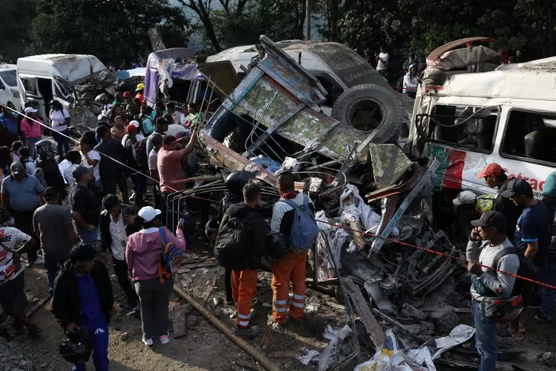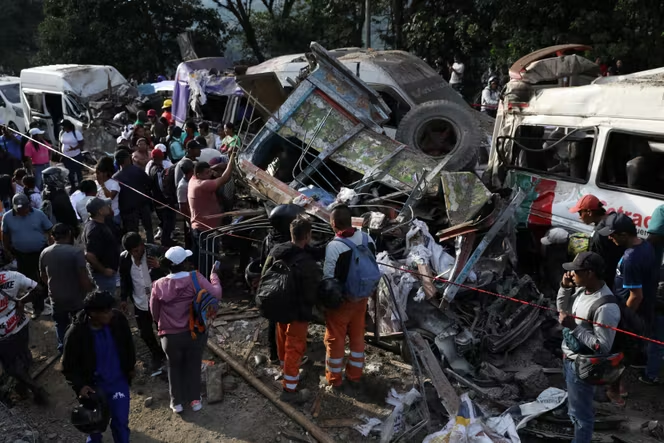
The roadside bomb exploded in a surge of violence blamed on FARC dissidents just weeks before the country’s presidential election.
A bombing on a highway in the volatile Cauca region of southwestern Colombia claimed 19 lives and injured at least 38 on Saturday.
The attack marks another grim episode of violence in the lead-up to next month’s presidential election.
Authorities have attributed the incident to remnants of the now-defunct FARC guerrilla army, a group infamous for sowing unrest across the country, particularly in conflict-prone areas associated with coca cultivation.
President Gustavo Petro took to social media platform X to condemn the attackers, labeling them as “terrorists, fascists, and drug traffickers.” He vowed to deploy Colombia’s “very best soldiers” against the perpetrators, whom he accused of endangering national security. Petro laid blame for the attack on Ivan Mordisco, Colombia’s most-wanted criminal, likening him to notorious drug lord Pablo Escobar.
As of Saturday night, Governor Octavio Guzman reported the death toll at 14, though this was later updated to 19. More than 38 people, including five minors, were injured, and rescuers continue searching for additional casualties among the debris.
The explosion left severe destruction along the Pan-American Highway. Passenger buses and vans were mangled, cars overturned by the blast’s sheer force, and a massive crater now scars the roadway. Victims’ bodies were seen lying amidst the rubble, draped with sheets. According to military chief Hugo Lopez, the attackers set up a blockade using a bus and another vehicle before detonating the bomb in what he described as “a terrorist attack against civilians.”
The violence came on the heels of another bombing Friday at a military base in Cali, Colombia’s third-largest city, which injured two individuals and sparked a chain of assaults in the Valle del Cauca and Cauca regions. Military officials report that 26 such attacks occurred in these departments over just two days.
Defense Minister Pedro Sanchez confirmed that security forces have been bolstered in response. Political turbulence remains deeply entwined with violence in Colombia, as armed groups—funded by drug trafficking, illegal mining, and extortion—seek to exert influence over the upcoming elections. Dissident factions of FARC have actively disrupted peace negotiations initiated by President Petro’s administration.
Security concerns have become a critical focal point ahead of the presidential election scheduled for May 31. Last year’s assassination of Miguel Uribe Turbay—a young conservative candidate—while campaigning in Bogota underscored the ongoing risks surrounding Colombia’s political landscape.
In this election cycle, leftist Senator Ivan Cepeda, one of Petro’s allies and a proponent of negotiating with rebel factions, leads in polls. He is followed by right-wing contenders Abelardo de la Espriella and Paloma Valencia, both of whom advocate for cracking down on armed groups. All three candidates have faced death threats and are campaigning under heightened security measures.