
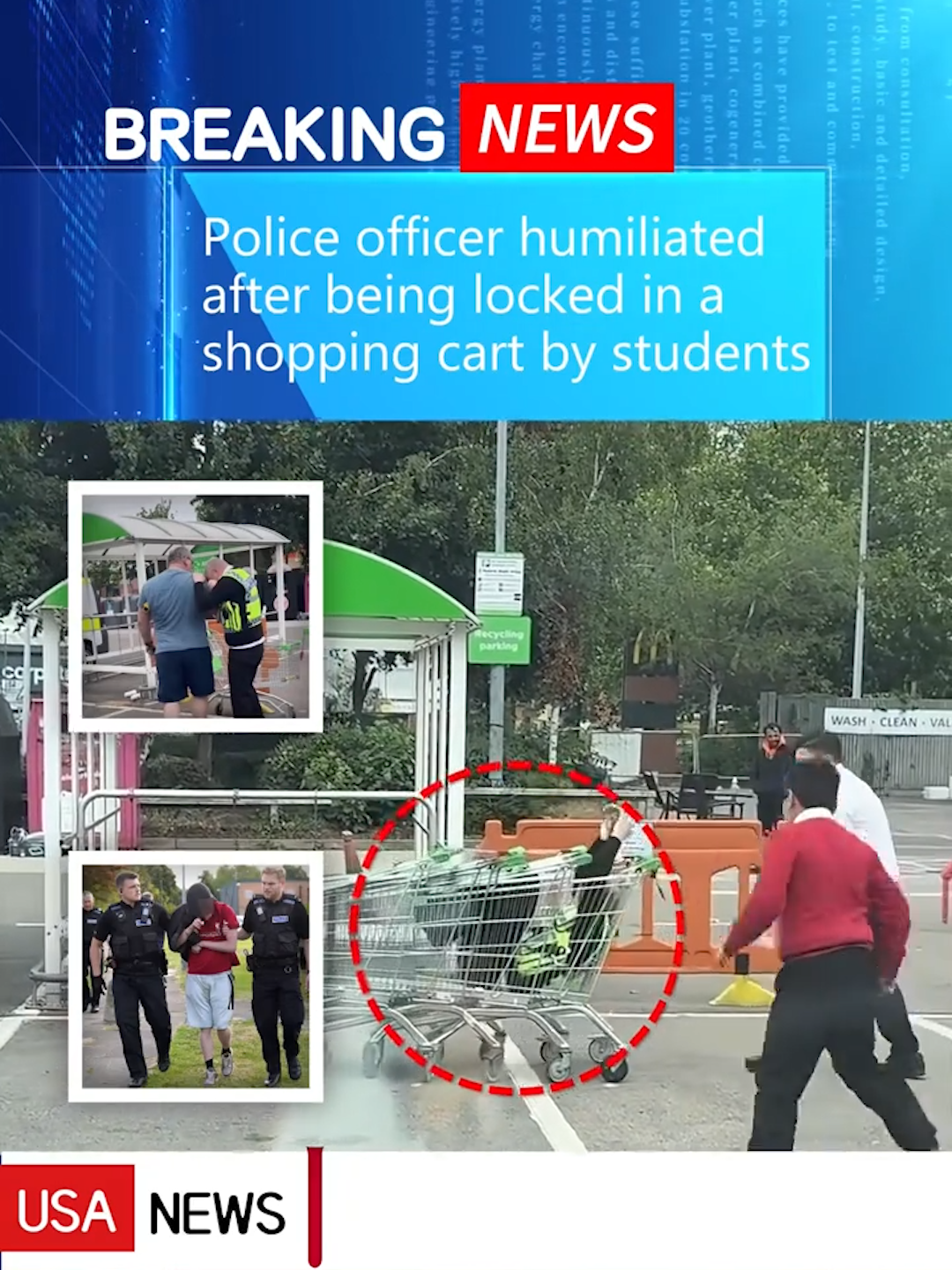
At first glance, it looks like a joke—one of those chaotic clips that spreads across the internet before anyone stops to ask questions. A shopping cart rattles across the floor of a supermarket, surrounded by laughter, phones raised, voices overlapping. But then something feels off. The figure inside the cart isn’t laughing. He isn’t playing along. He’s a police officer. And somehow, in a moment no one fully understands yet, he’s been locked inside—unable to step out, unable to regain control of a situation that’s slipping further away with every second. The camera keeps rolling, as if capturing something ordinary, but what unfolds is anything but that.
The longer the video continues, the more uncomfortable it becomes. What might have started as a reckless stunt begins to take on a sharper edge. A kick lands against the side of the cart. Then another. The officer shifts, trying to steady himself, his face tightening—not with anger, but with something quieter and harder to watch. Around him, the students don’t seem to register the shift. Their laughter fills the space, echoing in a way that feels detached from reality. It raises a question that sits heavily in the mind of anyone watching: at what point did this stop being a joke? Or worse—did anyone there even notice when it did?
And then there’s the silence behind the camera. The person filming doesn’t intervene. They don’t speak up. They document. Others nearby linger at the edges, watching, hesitating, choosing not to step forward. Time stretches in a strange way, each second adding weight to the moment. Until finally, almost unexpectedly, a passerby enters the frame. No hesitation, no performance—just action. The cart is unlocked. The officer steps out. The laughter fades. And suddenly, the scene feels exposed, like a curtain has been pulled back on something no one fully wanted to see.
What followed was as swift as it was inevitable. The video spread rapidly, drawing outrage from across communities who saw more than just a moment of misbehavior—they saw a breakdown in respect, in judgment, in basic human decency. Investigations identified the students involved, and disciplinary action came down heavily. Expulsions were announced. Statements were issued. The school emphasized accountability, promising stronger efforts to teach ethics and respect for the law. On the surface, it seemed like a clear resolution: actions met with consequences.
But beneath that resolution, the discomfort lingers. Because this wasn’t just about a group of students making a bad decision. It was about the environment that allowed it to escalate unchecked—the bystanders who watched, the camera that kept recording, the hesitation that delayed intervention. It forces a deeper reflection on something less visible but more pervasive: the normalization of treating real moments as content, as something to capture rather than confront. In that space, empathy can erode quietly, replaced by curiosity or even indifference.
In the end, the officer drove away, leaving behind a scene that quickly returned to normal on the surface. The students faced their consequences, the school moved forward, and the internet eventually shifted its attention elsewhere. But the story doesn’t really close there. It settles into the background, lingering in the questions it leaves behind. Because the next time a moment like this begins—whether in a supermarket, a street, or anywhere people gather—the outcome may depend less on rules or punishments, and more on a single, simple decision: whether someone chooses to step in before the line is crossed, or keeps watching as it disappears.