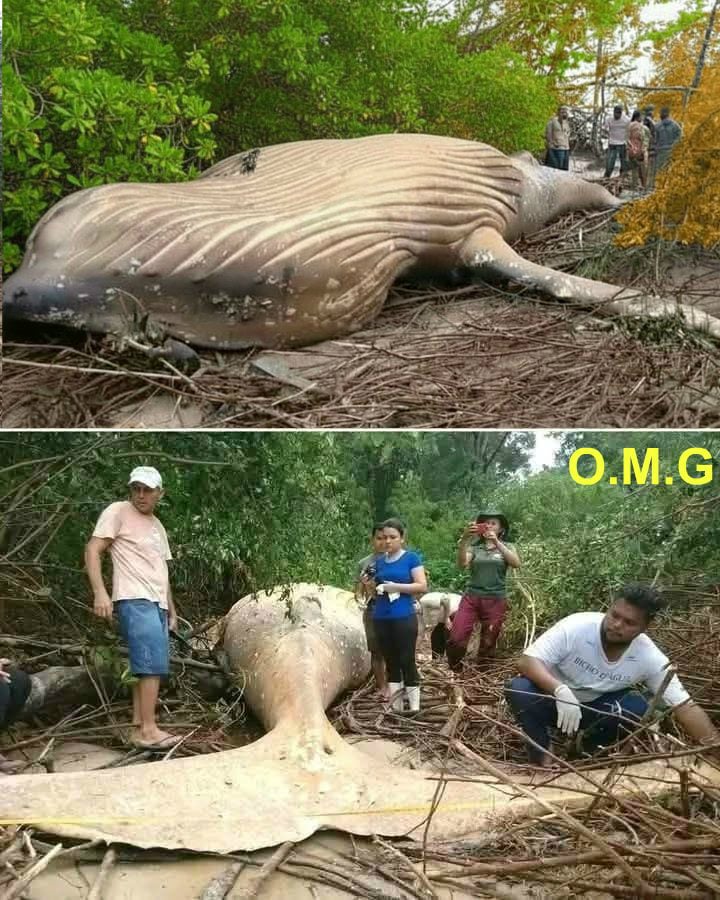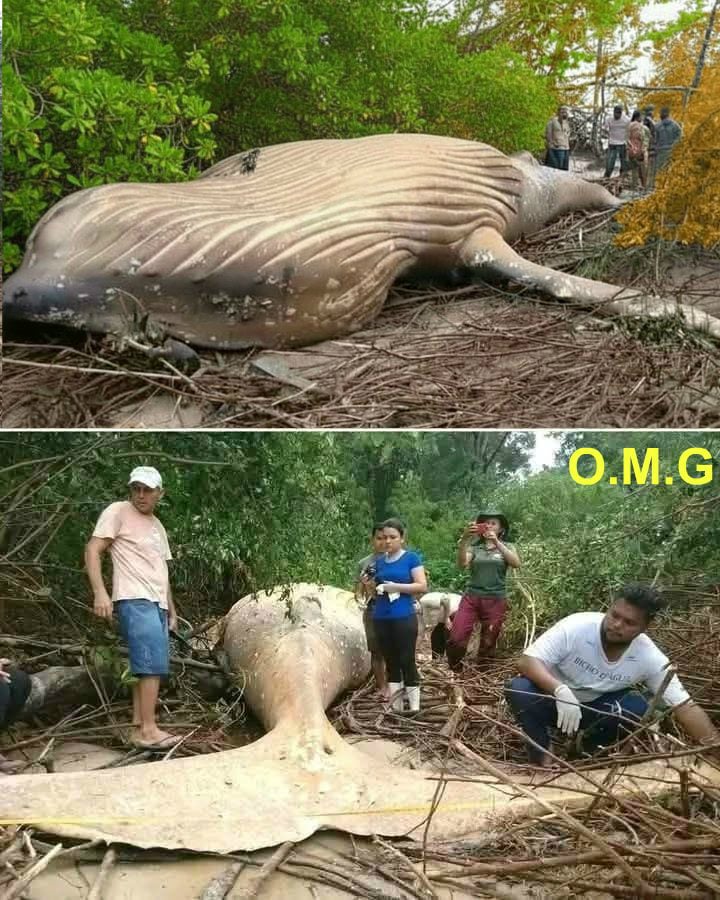
When residents of Brazil’s Marajó Island first came across the body, many could hardly believe what they were seeing. Lying among tangled roots, thick vegetation, and damp forest ground was a young humpback whale, far from where any whale should have been. The animal measured about eight meters long, and its massive body looked almost impossible in that setting — not floating in the open sea, not stranded on a beach, but resting inside the greenery as if nature itself had made a mistake.
The discovery immediately drew attention because of how strange it appeared. Marajó Island sits near the mouth of the Amazon River, where freshwater, ocean tides, mudflats, and flooded forest meet in a dramatic and unpredictable landscape. Still, even in a place shaped by powerful water movements, the sight of a whale in the forest felt shocking. To the people who found it, the scene looked less like an ordinary animal death and more like a warning.
Authorities and specialists quickly stepped in. A special team was formed to investigate the case, including biologists and environmental officials who wanted to understand how such a large marine animal could end up so far from the open water. At first glance, the situation seemed almost supernatural. There were no obvious signs that the whale had been dragged there by people. There was no simple explanation that made the image feel normal. It was simply there — silent, enormous, and completely out of place.
As experts examined the scene, one theory became more likely than the others. Biologists believed that a powerful ocean tide may have carried the young whale ashore and pushed it inland before the water retreated. The carcass was reportedly found around 15 meters from the shoreline, hidden in the undergrowth near the edge of the Amazon region. In an area where tides can rise forcefully and flood wide stretches of land, it was possible that the sea had briefly reached into the forest, delivered the whale there, and then pulled back as if nothing had happened.
That explanation was logical, but it did not make the discovery feel any less disturbing. The whale had no clear visible injuries that immediately explained its death. There was no obvious evidence of a violent struggle. Some experts believed the calf may have already been dead before it was washed inland, while samples were taken to help understand what had happened. The animal was believed to be young, possibly around a year old, making the scene even more tragic.
For many observers, the most haunting part was not only that the whale died, but where it died. Whales belong to vast spaces — deep water, long migrations, open horizons. Seeing one trapped among trees and roots created a powerful sense of wrongness. It was a reminder that nature does not always follow the clean boundaries humans imagine. The ocean does not stop simply because a map says land begins. In places like Marajó, the line between river, sea, swamp, and forest is constantly shifting.
The event also raised questions about the whale’s journey. Humpback whales are known for long migrations, and young calves can become separated, weakened, or disoriented. Some reports noted that the discovery was unusual for the time of year, adding another layer of mystery to the case. But experts were careful not to turn uncertainty into fantasy. The most likely explanation remained a combination of death, tide, and geography — rare, dramatic, but possible.
In the end, officials decided the carcass would be left to decompose naturally. Removing such a large animal from dense, difficult terrain would have been extremely challenging. Over time, nature would do what it always does: break down what remains, return it to the soil, and leave only the bones behind. The skeleton was expected to be collected for study and eventually displayed, transforming a strange and unsettling discovery into a scientific record.
But even stripped of mystery, the image remains powerful. A young humpback whale lying in the forest is the kind of scene people remember because it seems to belong to a dream, a myth, or a warning from the natural world. Science may explain how it happened, but explanation does not erase the feeling it leaves behind.
In a world where satellites map oceans, researchers track migrations, and nearly every strange event can be photographed within seconds, some moments still stop people cold. The whale of Marajó Island was one of those moments — a reminder that even now, nature can place something familiar in the wrong world and make everyone look twice.